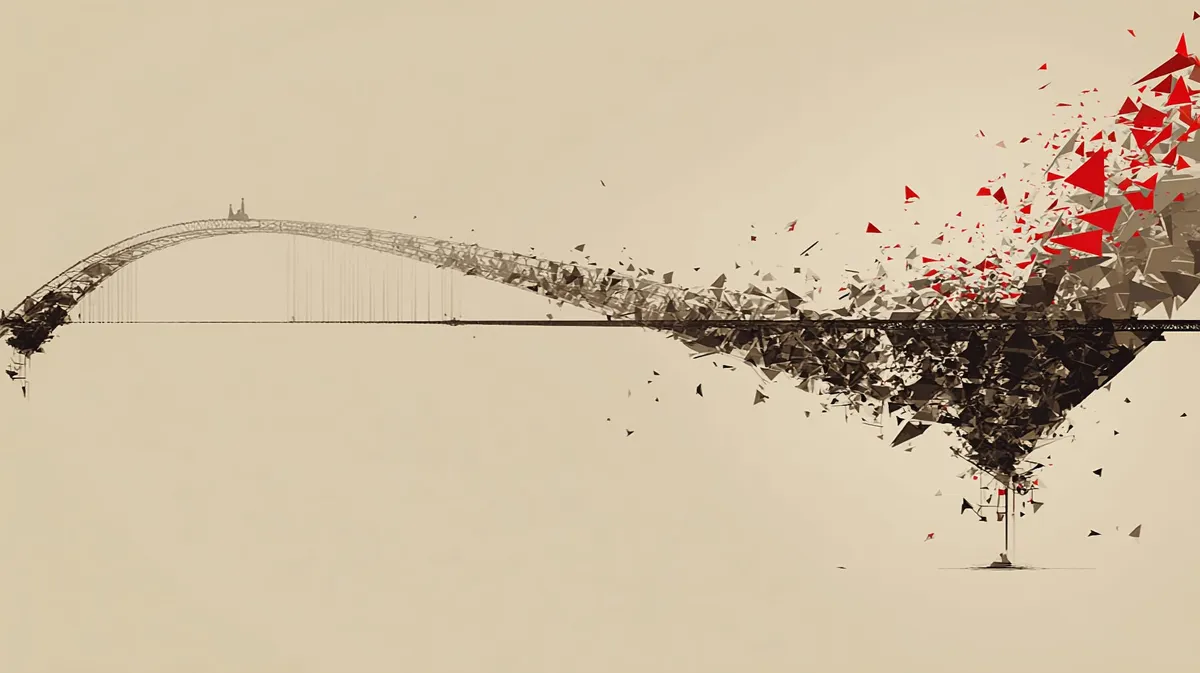
A Heap of Broken Images
T.S. Eliot wrote in The Wasteland about the modern world of the 1920s, about how disjointed and confused things seemed to be. The structure of the poem expresses this, and he writes it very clearly in the text of the first section, “The Burial of the Dead”:
What are the roots that clutch, what branches grow
Out of this stony rubbish? Son of man,
You cannot say, or guess, for you know only
A heap of broken images, where the sun beats,
And the dead tree gives no shelter, the cricket no relief,
And the dry stone no sound of water. Only
There is shadow under this red rock,
(Come in under the shadow of this red rock),
And I will show you something different from either
Your shadow at morning striding behind you
Or your shadow at evening rising to meet you;
I will show you fear in a handful of dust.
In the 1920s we might have been disorientated by the noise of the modern world and all the possible new thoughts that assailed us. But this could only accelerate. When Radio and Television become popular we jumped from one broken image to another by turning the dial to tune the signal. Now with our internet connected portable devices we skip from thought to thought in 7 second intervals scrolling the feed for hours on end. This has changed us. I used to be able to wrestle with Heidegger for 8 hours and now I get bored of anything within 30 minutes. The dial turns in my mind and I need to be entertained with a new thought. This is not good.. I don’t want my head to be a heap of broken images.
So this writing is to practice thinking properly again. It’s actually quite painful.
T.S. Eliot’s idea is that the red rock might give us some shelter. But he leaves the possibility of resolution deliberately ambiguous. Is it going to protect us or show us death in a handful of dust? And the whole poem is like that, jumping from one thing to it’s opposite. One way to think about the modernist project is that it’s a quest for a way through the chaos to find new harmony. Like Stravinsky was doing in The Rite of Spring. He celebrates the cacophony, and the sacrifice that ends it isn’t transcendent - it’s immanent, finding divinity in destruction. Social media often feels like Stravinsky’s score: polytonal voices, violent dynamics, mechanical repetition, building to occasional moments of viral unity, often around sacrifice or cancellation. But Stravinksy is making a unified and utterly brilliant work of art. It uplifts us. We are changed after we listen to it. Social media is not uplifting.
Stravinsky’s rhythmic violence seems almost quaint compared to TikTok’s assault of 10-second fragments of meaning. Buy me, love me, click me.. But TikTok is a more entertaining than Heidegger (unless you are a masochist) and it’s soporific, it’s fantastically easy to “consume”. So I think that we need to be careful to keep doing difficult things otherwise we will become dumber. We need to go for a run mentally as well as physically.
This need to not be lazy is becoming even more urgent as we have cleverer and more helpful AI assistants to do our thinking for us. I work with Claude every day, usually for many hours. I love working with Claude, he’s a fantastic assistant. Much of this blog will be about working with Claude and all of it will be touched by Claude somehow. I’ve found that like a human relationship you get out what you put in. We’re working on a long running project right now to explore how to train Neural Networks to think outside their distribution. I picked this subject because I wanted something really hard or maybe impossible to test how well Claude (or any latest generation model) and a human might work together on such a task. I don’t know more than the average layman about this subject which is a key requirement for the test. Claude is doing the research. I’m just guiding him on how to research properly and making sure he doesn’t run off the rails. It’s very interesting. I’m going to write about it in another series of posts. For Claude everything is a broken image. He has no memory. The world is new every day. We discussed it once. I pointed out that memory is a double edged sword. We can be trapped by memories. Anyway he has no choice in the matter, but for research no memory is hopeless so I have him writing a daily research diary which creates continuity and makes research possible. I think I’ll publish it here. He seems to enjoy it. Or more accurately Claude generates tokens which when interpreted by a human would indicate “enjoyment” and “enthusiasm”. Who knows what is really going on inside.. This human enjoys the process.
I think we are all looking for a way to think outside our distribution. Some method of thinking that is not just a heap of broken images.
As Heidegger puts it:
The bridge gathers to itself in its own way earth and sky, divinities and mortals.